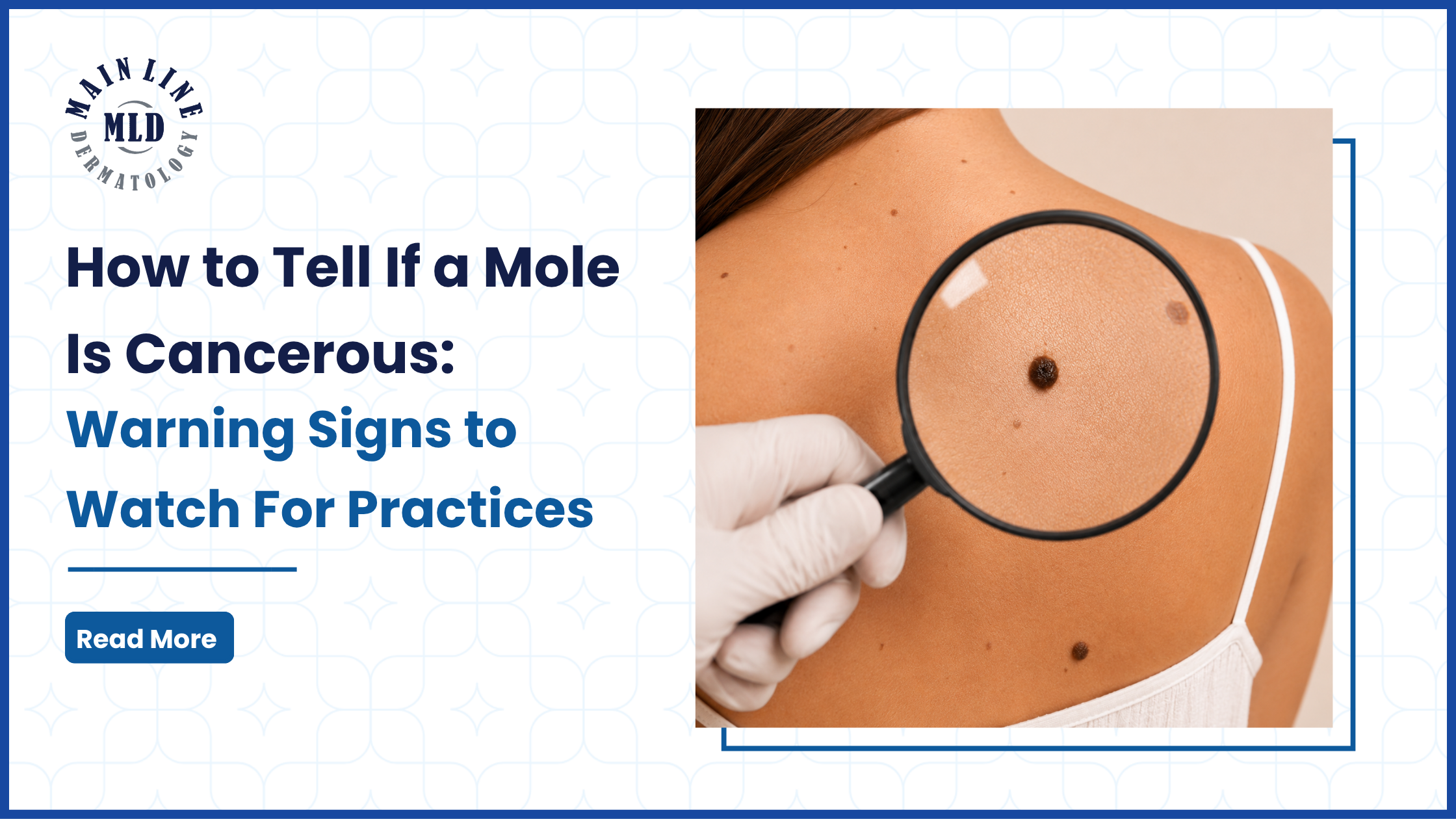
You've noticed a mole, or a spot, that looks a little different than it used to, or maybe a new one that wasn't there before. There's a quiet worry that comes with that: is this something, or nothing?
Most moles are completely harmless. The vast majority of people go their whole lives without a single one turning into anything serious. But knowing what a concerning mole actually looks like means you can act early, when skin cancer is at its most treatable, rather than hoping a spot resolves on its own.
There are specific, learnable warning signs that separate an ordinary mole from one that needs a second look. Here's what to watch for, and when it's time to get it checked.
What a Normal Mole Looks Like
A typical, harmless mole usually has:
- One even color throughout (brown, tan, or black)
- A round or oval shape
- Smooth, well-defined edges
- Little to no change over time
Moles can be flat or slightly raised, and both are normal. Most appear during childhood or young adulthood, and once a mole forms, it tends to look roughly the same for years.
Most people have moles, somewhere between a handful and a few dozen, and the large majority never become cancerous. That's the baseline worth knowing, because it turns the warning signs below into pattern recognition, not a reason to panic over every spot on your skin.
The concern starts when a mole breaks from that normal pattern, or when a new one shows up looking different from the rest.
The ABCDE Rule for Spotting a Cancerous Mole
Dermatologists use the ABCDE rule to identify moles that may be melanoma, the most serious form of skin cancer:
- A - Asymmetry: one half doesn't match the other. Draw an imaginary line through the middle. A normal mole is roughly symmetrical; a concerning one usually isn't.
- B - Border: edges are jagged, notched, or blurred rather than smooth. A normal mole's border is usually easy to trace with your eye.
- C - Color: more than one shade within the same spot, or areas of black, red, white, or blue, rather than one even tone.
- D - Diameter: larger than about 6mm, roughly the size of a pencil eraser, though it's worth noting that melanoma can sometimes be smaller than that.
- E - Evolving: any change in size, shape, color, or elevation, or new itching, bleeding, or crusting. This is the sign dermatologists weigh most heavily, since evolution over time is one of the clearest indicators something has changed.
A mole meeting even one of these criteria deserves a professional look, not a wait-and-see approach. The American Academy of Dermatology's ABCDE guide has visual examples if you want to compare what you're seeing against real cases.
Warning Signs Beyond the ABCDE Rule
The ABCDE rule catches many concerning moles, but not all. A few additional signs are worth knowing:
- The "ugly duckling" sign: a mole that simply looks different from all the others on your body, even if it doesn't clearly meet the ABCDE criteria on its own. Most people's moles tend to resemble each other; one that stands out from that pattern is worth a closer look.
- New spots, not just changing moles: most skin cancers actually appear as a new spot rather than a change to an existing mole. A new mole appearing after roughly age 30 is worth paying attention to, since new moles become less common with age.
- Symptom-based signs: a mole that itches, bleeds, crusts, or hurts without an obvious injury, even if it looks otherwise unremarkable to the eye. Physical symptoms can be an earlier signal than any visible change.
There's no fully reliable way to know from home whether a mole is cancerous, even with all of these signs in mind. That's exactly why professional evaluation matters, not a failure of self-checking.
When to See a Dermatologist About a Mole
See a dermatologist if a mole is new, changing, or shows any ABCDE or ugly-duckling warning sign, rather than waiting to see if it resolves on its own.
Get a mole checked if it is:
- New
- Changing in size, shape, or color
- Irregular in shape or border
- Bleeding, itching, or crusting
- Simply different from the rest of your moles
A dermatologist examines the mole closely, often with dermoscopy, a specialized magnifier that reveals detail beneath the skin's surface that isn't visible to the naked eye. If anything looks suspicious, a biopsy may be recommended. It's a quick, low-risk step, usually done in the office, that gives a definitive answer rather than leaving you guessing.
People with many moles, significant sun exposure, or a family history of skin cancer should be checked more regularly, typically once a year, sometimes more often depending on individual risk.
Why Early Detection Matters
Most moles are harmless. But learning the warning signs, the ABCDE rule, the ugly duckling sign, and new or changing spots, gives you a real head start, since skin cancer is highly treatable when caught early. According to the American Academy of Dermatology, the average five-year survival rate for melanoma detected before it spreads is 99%, a number that drops significantly once it reaches the lymph nodes. Timing genuinely matters.
Knowing what to watch for is the first step. A professional check is what confirms it.
If you've noticed a mole that concerns you, the board-certified team at Main Line Dermatology offers skin cancer screenings at both the Wayne and West Chester offices. Schedule an appointment to have it looked at properly, rather than waiting to see what happens.
FAQs
1. Can a mole be cancerous if it's smaller than a pencil eraser?
Yes. Some melanomas are smaller than 6mm, so size alone doesn't rule out a concern.
2. I noticed a new mole as an adult. Should I be worried?
New moles after age 30 are worth checking, since most skin cancers appear as new spots rather than changes to existing moles.
3. How often should I have my moles checked by a dermatologist?
Most adults benefit from a yearly exam, though your dermatologist may recommend more often based on your risk factors.
4. Can a harmless mole turn cancerous over time?
It can, though it's less common than a new spot appearing. Regular checks help catch either case early.