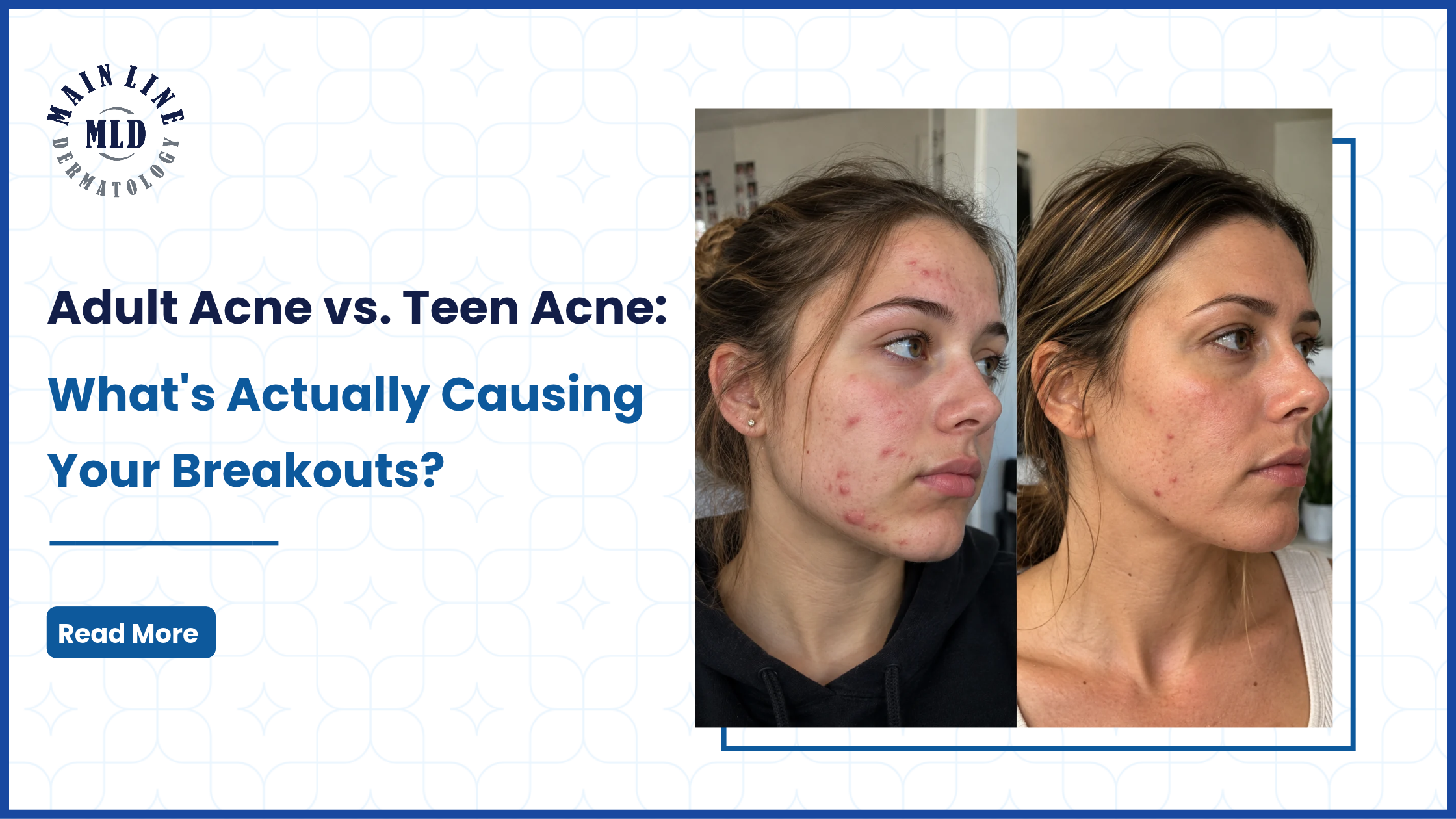
You had clear skin through your teens, maybe even prided yourself on it. Now, somewhere in your 20s, 30s, or 40s, breakouts have shown up uninvited, and the moisturizer that worked fine at 22 only seems to make things worse.
Or maybe acne never fully left after high school, it just changed shape and stuck around. Either way, the instinct is to reach for whatever worked at sixteen: a stronger spot treatment, a harsher cleanser, the same prescription a dermatologist wrote years ago.
Often, none of it works anymore. That is because while acne follows the same basic process at any age, what triggers it can look very different in adulthood, and that difference is what actually determines how to clear it.
What Teen and Adult Acne Have in Common
All acne, no matter your age, starts the same way. A pore becomes clogged with oil and dead skin cells, and bacteria that live naturally on the skin multiply inside it.
The surrounding skin responds with inflammation. That is the entire mechanism, whether the breakout shows up on a fifteen-year-old's forehead or a forty-year-old's chin.
Four things drive this process: excess sebum, the oil your skin produces; clogged pores, where that oil and dead skin cells build up; a bacteria called Cutibacterium acnes, which thrives in that clogged environment; and inflammation, the skin's response to all of it.
Because this underlying process does not change with age, acne can appear at any stage of life. Adult acne continues to increase and now affects up to 15% of women, according to the American Academy of Dermatology, so a breakout at 35 is not simply a leftover from adolescence.
It is a separate, and increasingly common, occurrence in its own right. What changes with age is what sets that process in motion in the first place.
What Causes Teen Acne
Teen acne is driven mainly by puberty. As hormone levels rise during those years, oil production in the skin increases right along with them.
Puberty triggers a surge in androgens, a group of hormones that includes testosterone, in both boys and girls. Higher androgen levels enlarge the skin's oil glands and prompt them to produce more sebum than the skin can easily manage.
That extra oil mixes with dead skin cells and can clog pores more easily during these years, which is part of why breakouts become so common in adolescence.
Genetics play a role too, along with naturally oily skin, sweat and friction from sports or tight clothing, and certain hair or skincare products that sit against the skin.
Teen breakouts tend to cluster on the forehead, nose, and cheeks, an area often called the T-zone. Blackheads and whiteheads are especially common in this age group, since they form where oil and dead skin build up fastest.
For most teenagers, this tends to ease with time. Hormone levels stabilize once puberty ends, and younger skin also turns over more quickly than adult skin, so breakouts tend to heal faster and any marks they leave fade sooner.
What Causes Adult Acne
Adult acne is driven less by puberty and more by hormonal fluctuation, which is part of why it often shows up in people who had clear skin all through their teenage years.
Hormones are the leading driver behind adult breakouts. Changes across the menstrual cycle, pregnancy, and perimenopause can all increase oil production and make pores more likely to clog.
There is a telltale pattern to this kind of breakout. Adult hormonal acne tends to cluster on the chin, jawline, lower face, and neck, rather than the forehead and nose where teen acne usually appears.
Women are affected more often than men, largely because of these recurring hormonal shifts, which repeat across the month and again across different life stages.
One note worth keeping in mind: persistent or sudden adult breakouts can occasionally signal an underlying hormonal condition. This is not the case for most people, but it is one more reason ongoing adult acne is worth a professional evaluation rather than repeated trial and error.
Other Adult Acne Triggers: Stress, Products, and Medications
Beyond hormones, several everyday factors can trigger or worsen adult breakouts.
Chronic stress is one of the most common. Stress raises cortisol levels, which can increase oil production and inflammation in the skin, so breakouts often flare during particularly demanding stretches of work or life.
Skincare, makeup, sunscreen, and hair products can also be a factor, a pattern sometimes called acne cosmetica. Pore-clogging ingredients tend to cause breakouts especially around the hairline and anywhere a product sits against the skin for hours at a time.
Certain medications can contribute to acne-like breakouts as well. If you suspect a medication is affecting your skin, talk with the prescribing provider before making any changes. Do not stop a prescribed medication on your own.
Genetics and lifestyle matter too. A family history of adult acne, along with certain lifestyle factors, can raise the likelihood of ongoing breakouts.
Common Adult Acne Triggers:
- Hormonal changes tied to the menstrual cycle, pregnancy, or perimenopause
- Chronic or ongoing stress
- Pore-clogging makeup, sunscreen, or hair products (acne cosmetica)
- Certain prescription medications
- A family history of adult acne
- Everyday lifestyle factors, including sleep
How Adult Acne Looks Different From Teen Acne
Because the causes differ, adult and teen acne often look different too, even though the underlying mechanism is identical. Here is a general comparison of how the two typically present.
| Teen Acne | Adult Acne |
|---|---|
| Often begins during puberty | May begin for the first time in adulthood |
| Frequently affects the T-zone and forehead | Often appears around the chin, jawline, and lower face |
| Blackheads and whiteheads are common | Inflamed or deeper lesions may be more common |
| Strongly associated with puberty-related hormones | May be linked to hormonal fluctuations, medications, stress, or products |
| Often occurs with oilier skin | Can occur even when skin is relatively dry |
These are general patterns rather than hard rules. Plenty of people fall somewhere in between the two columns, and acne can look different from person to person regardless of age.
When to See a Dermatologist About Adult Acne
If adult acne is persistent, painful, or leaving scars, a dermatologist can identify what is actually driving it and tailor a treatment plan. This usually works better than cycling through one over-the-counter product after another.
A few signs it is worth scheduling that evaluation:
- Acne that appears suddenly in adulthood
- Persistent or worsening breakouts
- Painful, deep, or cystic acne
- Acne that scars or leaves dark marks behind
- Breakouts that do not respond to over-the-counter products
- Acne that affects your confidence or daily life
A dermatologist can distinguish acne from look-alike skin conditions that are sometimes mistaken for it. They will also look at your breakout pattern, medical history, current medications, and skincare routine to help pinpoint what is actually driving your specific breakouts.
Treatment is matched to the type, severity, and cause of the acne. Depending on what is found, that might mean topical treatments, hormonal treatment options, or in-office procedures for certain cases.
Getting to the Real Cause of Your Breakouts
Adult acne is not simply teen acne that never went away. Even though the underlying process is identical at any age, the triggers and patterns behind adult breakouts are often quite different from whatever caused acne during your teenage years.
Identifying the actual cause behind your specific breakouts, rather than repeating a skincare routine built for sixteen-year-old skin, is what actually leads toward clearer, healthier skin over the long term.
If your breakouts have been sticking around longer than they should, the team at Main Line Dermatology can help you find out why, at either the Wayne or West Chester office.
Schedule an appointment to talk through what is actually behind your skin's current pattern.
FAQs
1. Does adult acne go away on its own?
Some mild breakouts may settle on their own, but persistent or recurring adult acne often needs active treatment to prevent scarring and ongoing inflammation. Waiting it out is not always the safest approach, especially for deeper or inflamed breakouts.
2. Is adult acne always hormonal?
No. Hormones are the most common driver, but products, medications, genetics, and stress can all contribute as well, which is part of why the exact cause is not always obvious without a closer look.
3. Can the products I used as a teenager still work for adult acne?
Often not. Adult breakouts tend to have different triggers and tend to appear in different areas of the face, so a routine built for teenage skin may not address what is actually driving adult breakouts.
4. Can adult acne cause scarring?
Yes. Adult skin tends to heal more slowly than teenage skin, so deeper or inflamed breakouts carry a higher risk of leaving marks or scars behind. Earlier evaluation can help protect the skin from this outcome.